Design
This projects consists of 3 modules.
imalert-ui : This module has been written in python-django and provides the user interface for configuring the alerts.
imcontroller : This module has been written in Java and works as a controller for the monitoring jobs to be executed. This module sends the jobs for execution at the time when they are supposed to be, as per the schedule configuration provided by the user.
imworker : This is another module written in Java which works as a worker. This module receives the jobs sent by the controller and executes them. There can be run N number of worker’s instances as per the need.
How do these modules communicate with one-another ?
This project has another component in place which can be considered as the heart of this project. That component is a Redis server. The Redis server is logically in the center of these modules and acts as a communication medium for them. Let us understand it using the diagram below.
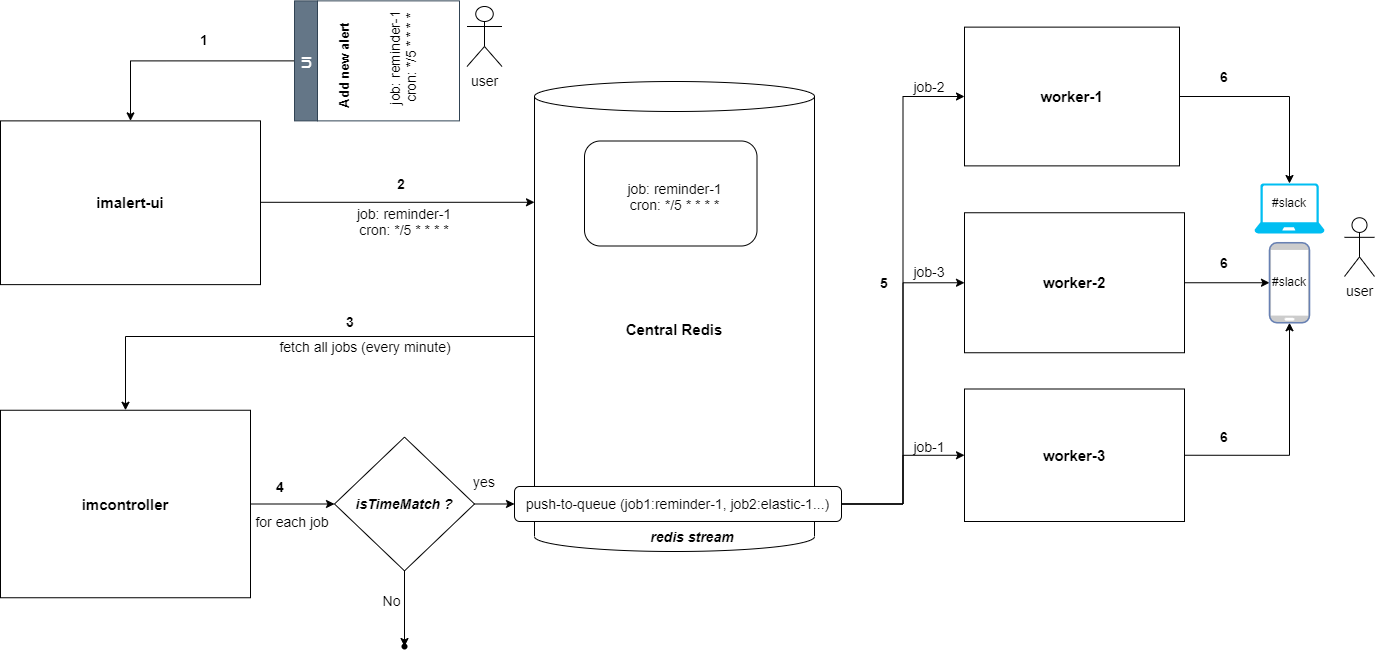
The user adds a new monitoring job through the UI
imalert-ui module writes the job configuration and cron schedule to the Central Redis.
The controller fetches all the jobs and for each job, checks if the current time matches with the configured schedule time. If yes, pushes the job into the stream.
The worker instances consume the stream’s messages as a group (so that duplicate messages are not processed) and assigns each job to one of the worker threads. Note that the worker module uses the ThreadpoolExecutor and maintains a pool of threads.
Number of core threads,maximum number of threadsandworker queue sizeof the threadpool can be configured through the module’s property.On execution of a job, the worker fetches the configuration of that particular job from the central-redis and runs the operation(s).
If the result is not meeting the expectations set by the user, the worker sends an alert on the configured slack channel.